
Enterprise Architecture and Technology Strategy
Know what you have, decide what you need, and sequence the work so it can be funded.
Technology estates rarely fail from a single bad decision. They fail from years of reasonable decisions made without a shared target state, until integration costs exceed the value of new work and nobody can say with confidence what a change will break.
We establish the architecture baseline, define a target state your executive team agrees on, and produce a roadmap with dependencies, cost shape and decision points made explicit.
When organisations call us
A transformation program has stalled and nobody can explain the end state
Systems have been acquired faster than they have been integrated
An architecture review board exists on paper but has no baseline to review against
A major platform decision is imminent and the business case rests on vendor material
An ERP, student management, billing or core platform is approaching end of support
Two organisations have merged and nobody owns the combined estate
What we do
Current state architecture. Application, data, integration and technology layers documented to the level of detail the decision requires, not to the level of detail the framework permits. Includes trust boundaries, integration points, lifecycle position and support risk.
Target state architecture. A defensible end state tied to business capability, not to a vendor roadmap. Cloud-first where it earns its place, pragmatic hybrid where it does not.
Transition roadmap. Sequenced initiatives with dependencies, indicative cost shape, and the decisions that must be made before each one starts.
Architecture governance. Practical governance that architecture review boards will actually follow: decision records, principles, reference patterns and a review cadence that fits the organisation's size.
Program architecture assurance. Independent review of an in-flight program against its own stated architecture, with a clear statement of what will not work and why.
Engagement Shape
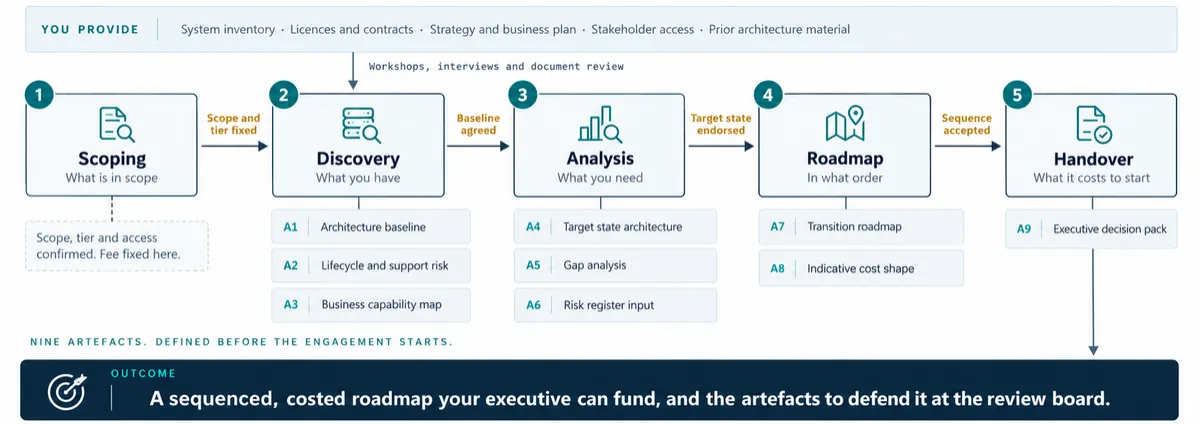
Most clients begin with the CLEAR Roadmap, which delivers the baseline, target state and roadmap as a fixed-scope engagement. Ongoing architecture governance, program assurance and review board support are available as a continuing arrangement once the baseline exists.
Method
Engagements are aligned to TOGAF 10 and adapted to the organisation. We use the parts of the ADM that produce decisions and leave the rest. Where a government client applies its own framework, such as the Queensland Government Enterprise Architecture, we work to that instead.
The architecture work is grounded in what the organisation can actually operate. Upgradeability, supportability, skills availability and total cost of ownership carry as much weight in a recommendation as technical fit.
Deliverables
Architecture Baseline
Current state across application, data, integration and technology, with lifecycle and support risk
Target State Definition
Capability-aligned end state, architecture principles, reference patterns
Gap and Risk Analysis
What stands between the two states, ranked by risk and dependency
Transition Roadmap
Sequenced initiatives, dependencies, decision points, indicative cost shape
Executive Decision Pack
The recommendation, the options considered, and what happens if nothing changes
Want to know more?
See how CLEAR works
Let's have a chat to discuss your estate
Copyrights 2026 | Fugleman Group | Terms & Conditions