
CLEAR - Connected Lean Enterprise Architecture Roadmap
Build an architecture practice that lasts, and a roadmap you can fund
CLEAR measures where your enterprise architecture stands, puts in place the few TOGAF® processes that will make the biggest difference, and uses them to deliver your technology roadmap. Scoped and priced before we start.
Book a scoping call
Free EA Maturity Check
Most roadmaps fail because nothing keeps them alive
Plenty of organisations have paid for a technology roadmap. Fewer have the architecture practice to keep it current. It usually looks like this:
A roadmap was delivered, then went out of date within a year
Projects are approved one at a time, with no check against a target state
Architecture standards exist, but nobody follows them and nobody checks
There's an architecture review board, and it reviews slides, not decisions
Every new initiative starts its own current state analysis from scratch
What the CLEAR Roadmap is
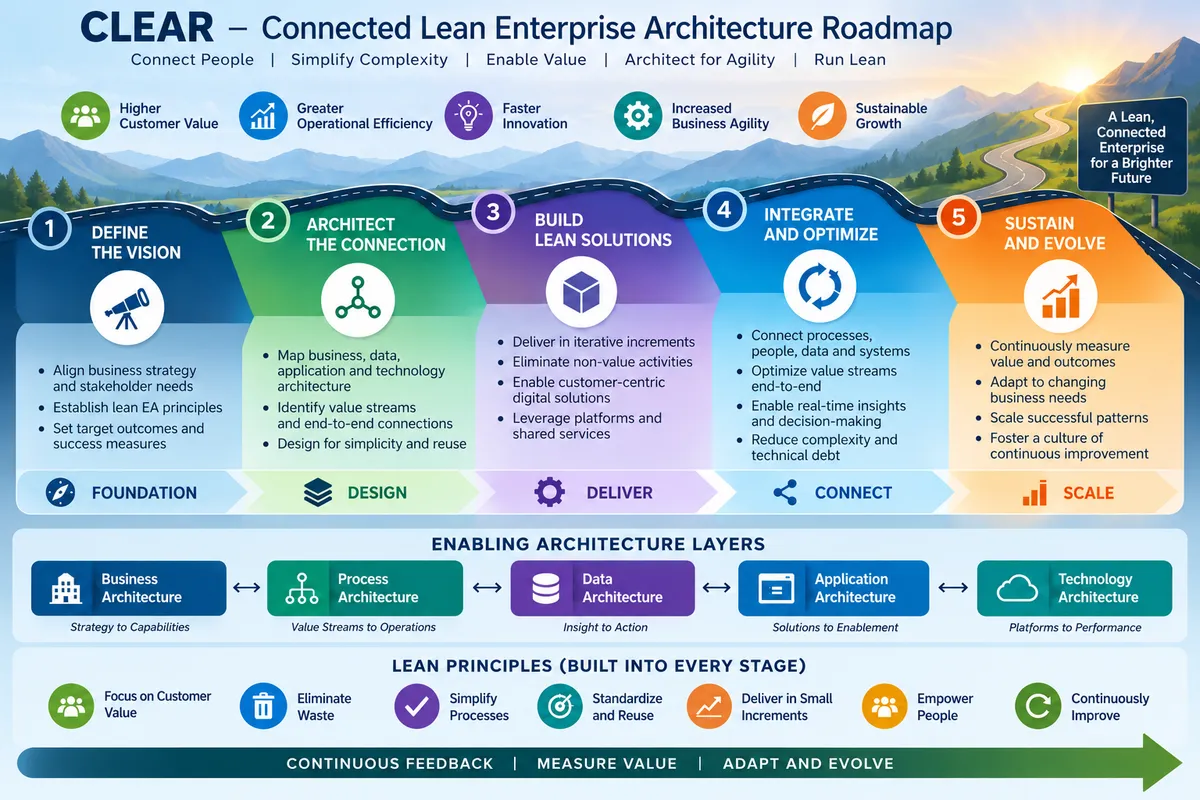
The CLEAR Roadmap (Connected Lean Enterprise Architecture Roadmap) is Fugleman Group's TOGAF® 10 based enterprise architecture engagement. It measures your architecture maturity, establishes the EA processes that will lift it most, and uses them to produce an architecture baseline, target state and costed roadmap that your organisation can maintain.
Connected
Business, data, application and technology architecture looked at together, because the problems sit in the joins.
Lean
Only the TOGAF® processes and artefacts that move your maturity. No shelfware.
Enterprise Architecure
Built on the TOGAF® 10 Architecture Development Method and Architecture Capability Framework, tailored to your size.
Roadmap
A plan the executive can fund, and a practice that keeps it current.
How a CLEAR engagement works
Each engagement is one bounded cycle. You finish with a roadmap and a working architecture practice, not just a document.
Measure: Baseline your architecture maturity on a 0 to 5 scale against the Architecture Capability Maturity Model referenced in TOGAF® guidance.
Target: Agree the maturity you need and choose the two or three EA processes that close the biggest gaps.
Establish: Stand up those processes with your people: principles, governance, repository, the templates and the routines that keep them running.
Deliver: Run the processes for real to produce your baseline, target state and roadmap, so your team learns them on live work.
Re-measure: Score maturity again, hand over the practice, and present the roadmap and decision pack to your executive or board.
The EA processes we target
We don't run all of TOGAF®. We pick the processes your maturity baseline says you need most. Common starting points:
Architecture principles & governance
`Preliminary Phase · Capability Framework` Agreed principles, decision rights and a review board that reviews decisions.
Architecture vision & business linkage
`Phase A` Architecture work tied to business goals and stakeholders before anything is designed.
Baseline & target architecture
`Phases B, C, D` Business, data, application and technology views, built once and kept current.
Opportunities and roadmap
`Phases E, F` Gaps turned into work packages, sequenced by value, risk and dependency.
Implementation governance
`Phase G` Projects checked against the target state, with compliance reviews that have consequences.
Change & requirements management
`Phase H · Requirements Management` A way to update the architecture when the business changes, so the roadmap doesn't go stale.
Maturity you can measure, not just describe
We baseline and re-measure across the nine characteristics of the Architecture Capability Maturity Model, so you can see what changed and report it to your board.
Architecture process
Architecture development
Business linkage
Senior management involvement
Operating unit participation
Architecture communication
IT security
Architecture governance
IT investment and acquisition strategy
What you recieve
Every tier draws on the same CLEAR artefact pack, mapped to TOGAF®10 and scaled to your scope.
Deliverable
Maturity Baseline and Re-measure
Architecture Baseline
Target State Definition
Gap Analysis and Transition Roadmap
Executive Decision Pack
TOGAF® reference
Architecture Capability Framework
Phases B, C, D
Phases A to D
Phases E, F
Phase F
What it contains
Scores across the nine ACMM characteristics at the start and end, with the gaps that remain
Current state across business, data, application and technology, with lifecycle and support risk
Capability-aligned end state, architecture principles and reference patterns
Work packages ranked by risk and dependency, decision points and indicative cost
The recommendation, options considered and what happens if nothing changes
Every artefact and process document is yours. No licence fees and no proprietary tool needed to read them.
Above are examples only and deliverables may vary depending on business needs, scope, size and vertical market
Choose the scope that fits your maturity
CLEAR FOUNDATION
from $32,000
Starting maturity | Little or no formal architecture (Level 0 to 1)
Principles and governance, plus baseline and roadmap
Typical duration | 6-8 weeks
CLEAR PRACTICE
from $50,000
Starting maturity | Some architecture, applied unevenly (Level 1 to 2)
Foundation + architecture vision and implementation governance
Typical duration | 8-12 Weeks
CLEAR ENTERPRISE
Scoped individually
Starting maturity | An established practice that needs to scale (Level 2 and above)
Practice + change and requirements management across entities
Typical duration | 12-16 weeks
Add what you need
Security architecture
Trust boundaries and control gaps against the ASD Essential Eight or NIST CSF 2.0.
Data and AI architecture
DAMA-DMBOK2 data governance and ISO/IEC 42001 AI governance built into the target state
Platform options analysis
An independent assessment of one major platform decision.
Program assurance
Phase G compliance reviews at delivery milestones.
Every engagement is scoped and priced upfront.
CLEAR, a consultancy roadmap, or a full TOGAF®rollout?
Maturity\
Output
Maturity
Scope of TOGAF
Who does the work
After it ends
CLEAR Roadmap
(Fugleman)
Roadmap plus working EA processes
Measured before and after
Only the processes you need
Seasoned Enterprise Architect, alongside your team
Your team keeps the roadmap current
One-off
consultancy roadmap
A roadmap document
not measured
Varies
Mixed team, often junior-led
Roadmap ages quickly
Full TOGAF®
Rollout
A complete architecture function
Usually measured, over years
All of it
Large team over a long program
Ongoing internal cost
Who is CLEAR for?
Organisations with a roadmap that went stale and no process to refresh it
New or struggling architecture functions that need a working method, not a framework course
Architecture review boards that need principles and a baseline to review against
Organisations facing a major platform decision, merger or end-of-support event
Executives who need a defensible roadmap before committing budget
Who isn't it for?
Organisations that need hands-on implementation. CLEAR builds the practice and the plan. Your team or your chosen delivery partner does the build.
After CLEAR?
Some clients run the practice themselves and come back for another cycle to lift the next set of processes. Others move to ongoing support through a Fractional CIO or virtual enterprise architect arrangement. There is no obligation to continue.
Why Fugleman
Senior, not junior
You work with seasoned, senior consultants directly. With 20+ years in enterprise architecture and technology leadership, TOGAF certified.
Practical TOGAF
TOGAF tailored to your business size and maturity, as the standard intends. Not the full, generic framework applied by the book
Vendor-neutral
No vender bias, reseller margins, managed services or product partnerships behind the roadmap.
Common Questions
What does CLEAR stand for?
Connected Lean Enterprise Architecture Roadmap. It is Fugleman Group's TOGAF 10 based method for measuring architecture maturity, establishing the EA processes that lift it, and producing a costed technology roadmap.
Is CLEAR a TOGAF implementation?
CLEAR is based on TOGAF 10, but it doesn't implement the whole framework. We tailor the Architecture Development Method and Architecture Capability Framework to your organisation and establish only the processes your maturity baseline says you need.
How do you measure architecture maturity
Against the Architecture Capability Maturity Model referenced in TOGAF guidance. It scores nine characteristics, from architecture process to IT investment strategy, on a scale from 0 to 5. We measure at the start and again at the end.
Do we need TOGAF certified staff?
No. Your team learns the processes by running them on your own roadmap. Certification is optional and not required to keep the practice going.
How long does a CLEAR engagement take?
6 to 16 weeks, depending on the tier and the size of your estate. We confirm the timeline in the scoping call before work starts.
How is CLEAR different from a fractional CIO?
CLEAR is a bounded engagement that builds the practice and produces the roadmap. A fractional CIO is ongoing leadership that owns and delivers it. Many clients do CLEAR first.
Ready to build a practice that keeps your roadmap current?
Book a 30 minute scoping call. We'll review your maturity, confirm the right tier and agree the price
TOGAF is a registered trademark of The Open Group
Get In Touch
